Mexico

A Body by the Donut Shop

Guadalupe shrine around the corner from our house....

How can we stand it here? Aren’t we scared? Even this evening, I talked to one of my friends back in the States – an old Mexico hand – who said the hysteria being whipped up by the U.S. press about the violence in Mexico is beyond absurd. She’s visited us here a couple of times and during her stay (many of  her friends told her not to come), we laughed about how the only thing we saw rolling around in the plaza — not severed heads — were a couple of little girls on their branny-new pink bikes because it was a couple of days after Christmas.

Still, you can’t blame our Stateside friends for being increasingly concerned. And it is true that while we have been in a little island of delusion here in the gringolandia of Ajijic and Chapala, the narcos are bearing down on us too as they battle for control of the Guadalajara routes and markets. They found a body just above the donut shop today. This is the donut shop where people go for coffee and morning gossip and which, in the days when I was still eating donuts, I was sure made arguably the best donuts I’ve ever had. No one seems to know who it is yet (a young Mexican male) but of course we’ll all know soon, after the police, such as they are, have done their investigations, and the news will be all over town.  We’ve had some police vs. narco “entre ellos”(between “them”) gunfights and the occasional grenade tossed around town but this is the first dumped body right in our village, right on the street we used to take to get up to my mother’s house.

You’d be crazy not to acknowledge that the noose (or whatever it is) is almost surely tightening around us, or so it would appear. But in spite of the near-certainty of the violence worsening here, even if we talk about leaving or doing something else, where would we go? Our lives are here, our home is here, we continue to love so many aspects of the life and culture; the friends we’ve made. If anyone should have fled soon after moving here, it would have been me, who was carjacked at gunpoint a few months after we got here (the subject of another tale, one of these days….) but somehow I bashed through my episodes of PTSD and flashbacks (the guy with the gun pointed at my head and all that…) and convinced myself that “this too shall pass” — which it did, sort of. Sort of is the operative description: I survived, obviously, but became a maniac about locking doors, locking our gates, looking over my shoulder all the time. I drive my husband crazy wanting to add more and more security; he says he doesn’t want to live in an armed camp. And neither do I, really, but I don’t want to be assaulted ever again, either. As if you could prevent it anyway.

I guess the thing that strikes you most (other than whatever injury you may suffer) about an adventure like that is the randomness and suddenness of it all, where someone springs out of the bushes or comes up behind you or however it happens; and that’s what is so scary about the narco stuff. I mean, they don’t put up posters like they do for the community dances that say “x time, x day, there will be a balacera (gun battle) so y’all come”. Some poor devil is on their list and he gets it in the middle of a restaurant where you’ve gone for a nice comida with friends; or on the sidewalk, and if you just happening to be walking by with your nylon market bag full of groceries, it’s curtains for you too, I guess. Hard to adjust to that reality, and to the idea that it’s probably going to get a whole lot worse before it gets better.

But we have sunk pretty deep roots here in the years we’ve been here, and at least for the moment, and it’s our home. Once I get behind our locked gates and hear the splash of our fountain, though, I do breathe a bit of a sigh of relief. For the moment.
Sofia’s First Class Overnight

Well, Our Girl actually got off on her class trip at the crack of dawn this morning, to  study rock formations and have “fellowship with students and teachers” –  to Tapalpa – a town up in the mountains about two hours from here. Rosa, who was really opposed to her going  till she brings her English grade up –  is fine with her going now. I had to intervene and say “look, she’s studying like mad, we have a meeting scheduled next week with her English teacher, this is a great chance for her to get out of her village and see something new and have some fun with her friends in a supervised way with a bunch of teachers chaperoning – let her go…her grades will be fine.” So Rosa reluctantly gave her permission for her baby to take off  on the trip and spread her wings just a little. And of course, as one could have predicted, last night I got a call from Sofi about 9 p.m. saying “please, madrina, can I borrow a proper suitcase from you? My mother wants me to put all my stuff in a nylon market bag and it just won’t fit” – I said, sure, come over, we have lots of luggage, you can borrow something.

Reading between the lines I thought that all the kids were going to show up with sort of reasonable duffle bags and trendy “weekender” luggage, and here comes Sofi with her mother’s plaid nylon bag for carrying onions from the market – NOT cool. Anyway they came running over here (ferried over by Danny in the truck as it was late) and we found a very nice black duffle bag of Arnold’s for her to borrow with lots of compartments, plus I gave her a quilted vest and a polarfleece jacket (was going to give them to her anyway as they are HUGE on me since I lost weight) so she’s got nice warm things to wear, Danny lent her some gloves too. The kids were all supposed to gather at school to get on buses at 7:30 this morning, so she’s off!

She gets back home Sunday night and I will be really curious to see if she had fun! Bet she will have a blast. She’s never spent a night away from home. I thought Rosa would be all teary-eyed but she has accepted the inevitable – that it’s time to let her break away from home and the familiar just a little bit – and she’s here cleaning and seems perfectly content. Only bummer is that our usually superb, warm, February weather has been displaced by a nasty ‘frente frio” – a cold front – and it’s cold and nasty and drippy-rainy out there. But I am consoling myself by saying “look, these kids are fifteen, they will still have a blast and it’ll be a big adventure for them all to be out of the clutches of their parents for the weekend….” One can only hope.

A Modest Quinceañera

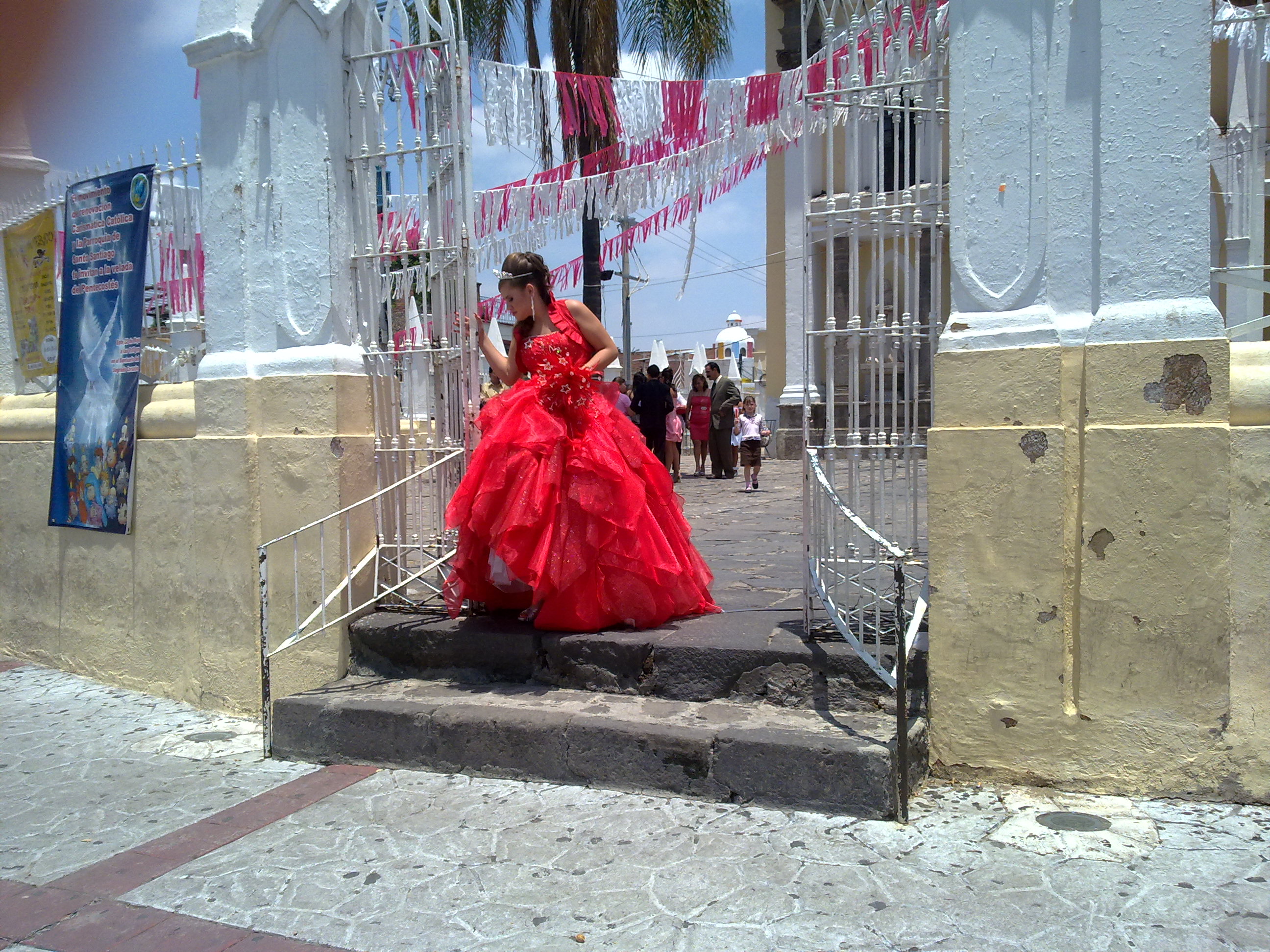
For a Mexican girl, her 15th birthday is an important moment, usually celebrated with a big party. Called a Quinceañera, it usually involves a special Mass in the local church, then a party with the birthday girl duded up in a dress that looks like an 18th century ballgown. Also required are a bunch of teenage guests, carefully vetted friends and relatives, little kids and babies, cake, food, and the inevitable ear-splitting band or DJ with the volume turned up to 10 or whatever the highest available number on the amplifier might be. Often people go completely nuts and spend a fortune on this party. Not too long ago, we watched from our rooftop (we live in a  working-class neighborhood with chickens running loose in the street and to call the street cobblestoned would be generous indeed) as the house next to ours threw a giant party for a local girl. She arrived at her party in a gown that looked like something out of the opera Der Rosenkavalier, with a feathered headdress. She was suitably delivered in a horse-drawn carriage, which paraded slowly down our impossibly dusty street, avoiding the stray dogs and kids riding around in circles on their bikes. The party went on till the early hours of the morning and we never will get used to the horrible noise these fiestas generate.

Here's what the traditional dresses tend to look like....

When we lived in Mexico City in the fifties, my mother thought the whole idea of a quinceañera was totally barbaric as the assumption was (I suspect that she was in some part correct) that after that milestone the girl was immediately available for marriage and babies. While I am sure that all of that was true in seventeenth century Mexico, as an American teenager I truly never gave any thought whatsoever to having such a party; that was something special for my Mexican pals but the whole deal just didn’t feel right for me. But now that I’ve seen more of what families go through as their precious niña approaches fifteen, I can see what my mother was concerned about. It involves a lot of money and – like big weddings – more of an opportunity to show off than anything else. My American mother did NOT want me having any sort of quinceañera or even the desire for one. In fact, she had begun to worry about how Mexican I was becoming and was concerned about my getting into college in the States. This was just one of a whole complex of issues that led to my family’s eventual return to California. My insistence that “nowadays it’s just a tradition and it hardly means that now that you’re in the 9th grade you should get married” carried no weight whatsoever.

Sofia, her niece America, and me after her Mass

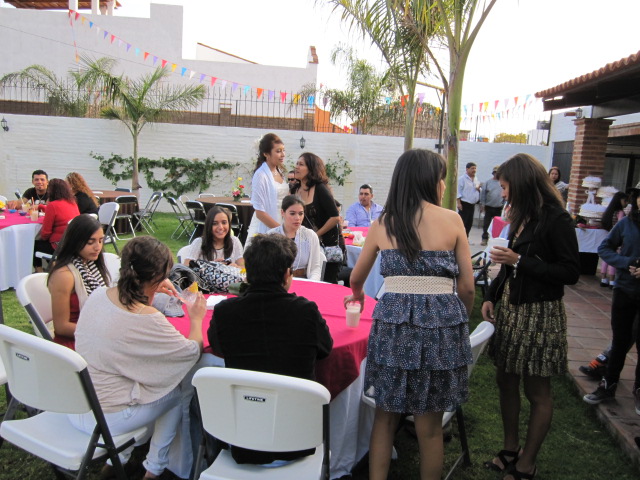
Although the traditions associated with quinceañera parties have changed quite a bit since then, certain aspects seem to remain ironclad in Mexican culture, and the list of “requirements” can make for a very expensive celebration. Since Sofia’s family works very hard and has few resources, all along the assumption was that she shouldn’t even have any celebration of her fifteenth birthday beyond maybe a family dinner with some pastel (cake). But for the first time in her life, she has a group of girlfriends (some boys too!) in her new school and it seemed like maybe we could do something modest – I offered our house and garden for a small fiesta for her family and a few of her friends. But an aunt in the States sent some money with a note that says “you only turn fifteen once, you should have a nice party”.  So an “evento” place was procured (sort of an outdoor garden you can rent for parties), invitations went out, and the family all agreed to make a bunch of food for the fiesta by themselves.

The whole family pitches in to make a feast for everyone!

My bright liberated-American woman-idea was that they shouldn’t have to shell out for a dress for Sofia which would be worn exactly ONCE, so I forked over my Eileen Fisher stretch velvet floorlength dress, which I thought could be cut down to fit Sofia relatively inexpensively. Only problem was, after ditzing around for two weeks with the date of the party and the accompanying special Mass in the church fast approaching, the ladies at the local alterations shop, having never seen such a dress, turned out to be terrified to cut into the (to them, at least) rare and expensive silk velvet. After endless excuses as to why the dress wasn’t ready, they finally admitted that they were afraid to touch the fabric and and scared of losing me as a client and scared of the whole business, but of course no one told me anything.

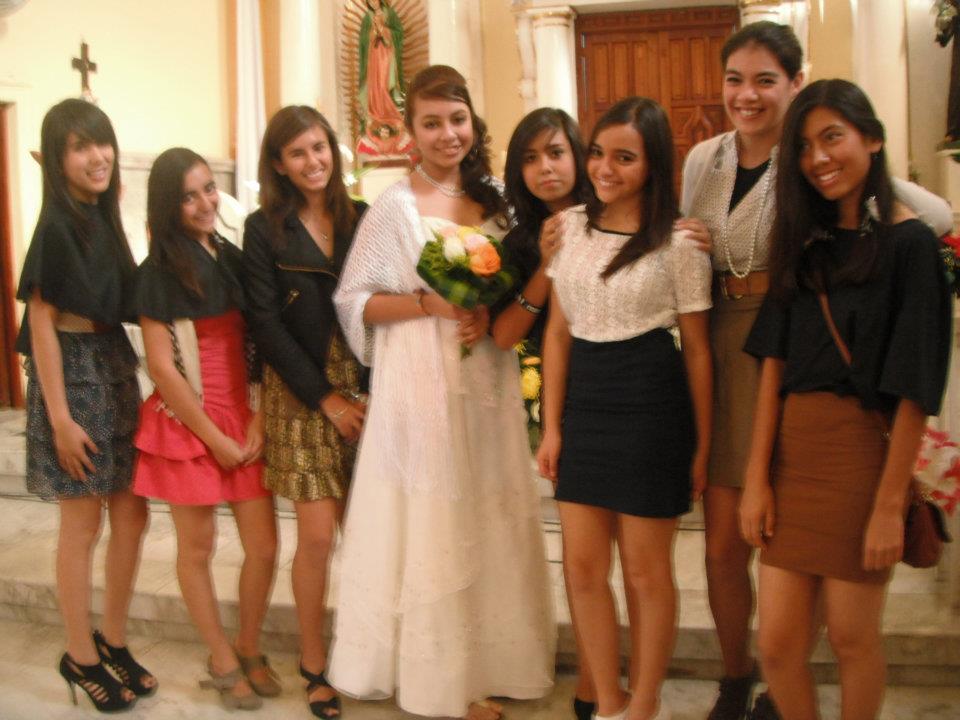
Frustrated by the ongoing stalemate, the day before the party, Rosa took Sofia on the bus and went to a larger nearby town to hunt for some sort of a party dress so the poor kid would have something even vaguely reasonable to wear. They found one that was floor length, gauzy white with sparkly things on it, (so far so good for church). Sofia protested that she looked like a bride, which annoyed her, but there were twelve hours to go and desperate times require desperate measures. Alas, the dress was also entirely backless and the padre said “no way are you coming to church in that dress, you have to wear a rebozo to cover yourself up. And make sure your friends cover THEMSELVES up too”.  Hence Sofi “covered up” and in the photos her girlfriends all appear wearing these little black capes provided by the church, since their dresses were (of course) either strapless or at the very least, pretty revealing on the top. As for the mini length of their skirts, I guess the padre just had to give a little since there was no way he was going to get these Mexican teenagers looking like Amish girls. Meantime, I thought Sofia should have something “borrowed” from me for the occasion, since I’m her madrina (godmother). So I put together a pile of jewelry, earrings, two of my best rebozos and a gorgeous enormous French silk scarf for her to borrow and sent it home with Rosa after she had finished cleaning for the day, for Sofia to pick out what she wanted.

Well, none of my American-lady-goes-to-the-opera stuff looked very Mexican and of course now I realize that it was totally out of style for a fifteen-year-old. Plus, Sofia is very independent and I should have figured that ultimately she would do her own thing. She arrived ready for her Mass in the backless dress – and with her hair done up with flowers by her two older sisters, and wearing makeup for the first time, looking gorgeous. Somewhere she found a white nylon crochet rebozo that was much more Mexican-looking than my square meter of Parisian silk. The only thing she used of mine was a two-strand crystal neckace (which was perfect with the dress!).  The day after the party, Rosa was so worried about returning my stuff to me that she refused to get on the bus with it and made her son-in-law bring her in his truck with the loot (all of which is costume jewelry).

So, in the end, pretty much everything I tried to do was completely trampled by the persistence of Mexican culture. After I said “it’s crazy to spend a fortune on a silly party that lasts one day” her family scraped together as much money as they could, and with the support of Rosa’s sister in the States the food, evento place, and the long white dress were procured. They ended up with enough to have their own party for her in their own style – including the horrid DJ Sofia wanted (Rosa kept asking them to turn the music down, and they did for ten seconds, then turned it back up again, of course) so she and her friends could dance. No one could carry on any sort of a conversation over the racket. She wanted a limousine and that, too, she had! The distance from the church to the party place they rented was very short so to make the limousine more worthwhile, I gather, the custom here is that the kids all pile into it and they drive all around several local villages posing for snapshots, waving and carrying on, before finally arriving at the party.

Sofi and her "modest" friends in church

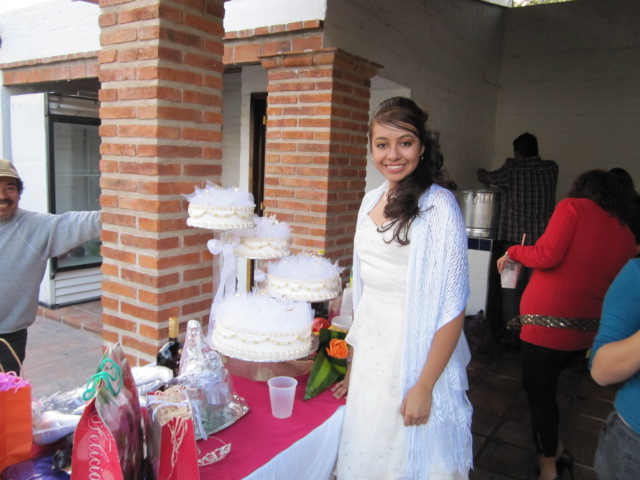
The whole family was there and several foreign friends of the family, as well as Sofia’s two volunteer English tutors. We all got put at a “gringo” table with much joking about being stuck at the “kids’ table”. But the real kids were all sitting with Sofia and it was great to see that her school friends came and seemed to have a great time.. The food was wonderful – people began arriving right after the mass with giant casseroles of stew, mole, potatoes with chile, corn and rajas (sliced chiles), all homemade and fabulously fresh. One of Rosa’s relatives came with a huge pot of masa (cornmeal) and she and two other ladies immediately got busy making the most fantastic tortillas, stacks of them. There was a three-tiered traditional white quinceañera cake, buckets of piña coladas and vampiros. I was wishing I had thought to bring some lo cal sugarless something to drink, when I saw the tortillas and said “I think I’m just going to blow this whole diet thing off today….” and I did. I wasn’t all THAT bad but still – oh well!  Then I found out that Rosa had ordered the cake and all the desserts made without sugar so I – who have cut all grains and sugar out of my diet in an attempt to NOT get the diabetes that is slowly killing my mother – could have a piece.  But why didn’t she tell me? It is a mystery.
My little video of the party is below if you can stand watching nine minutes of it! I know some of you know her and her family, so just for fun here is the whole thing.

Sofia and Rosa by the limousine


The party in full swing!


Sofia and her cake


Dia de los Muertos, November 2011

“the authentic and true death is forgetting”

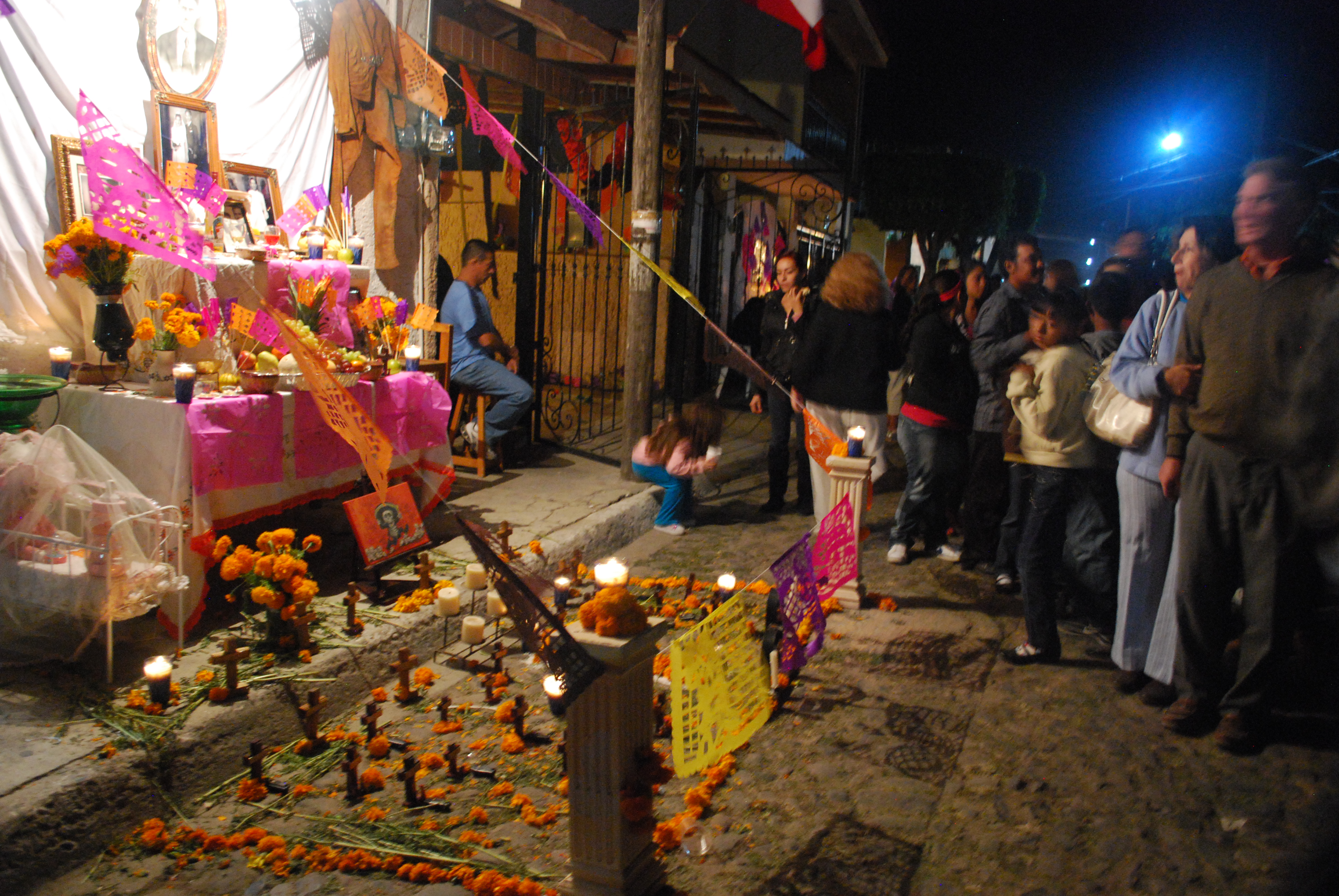
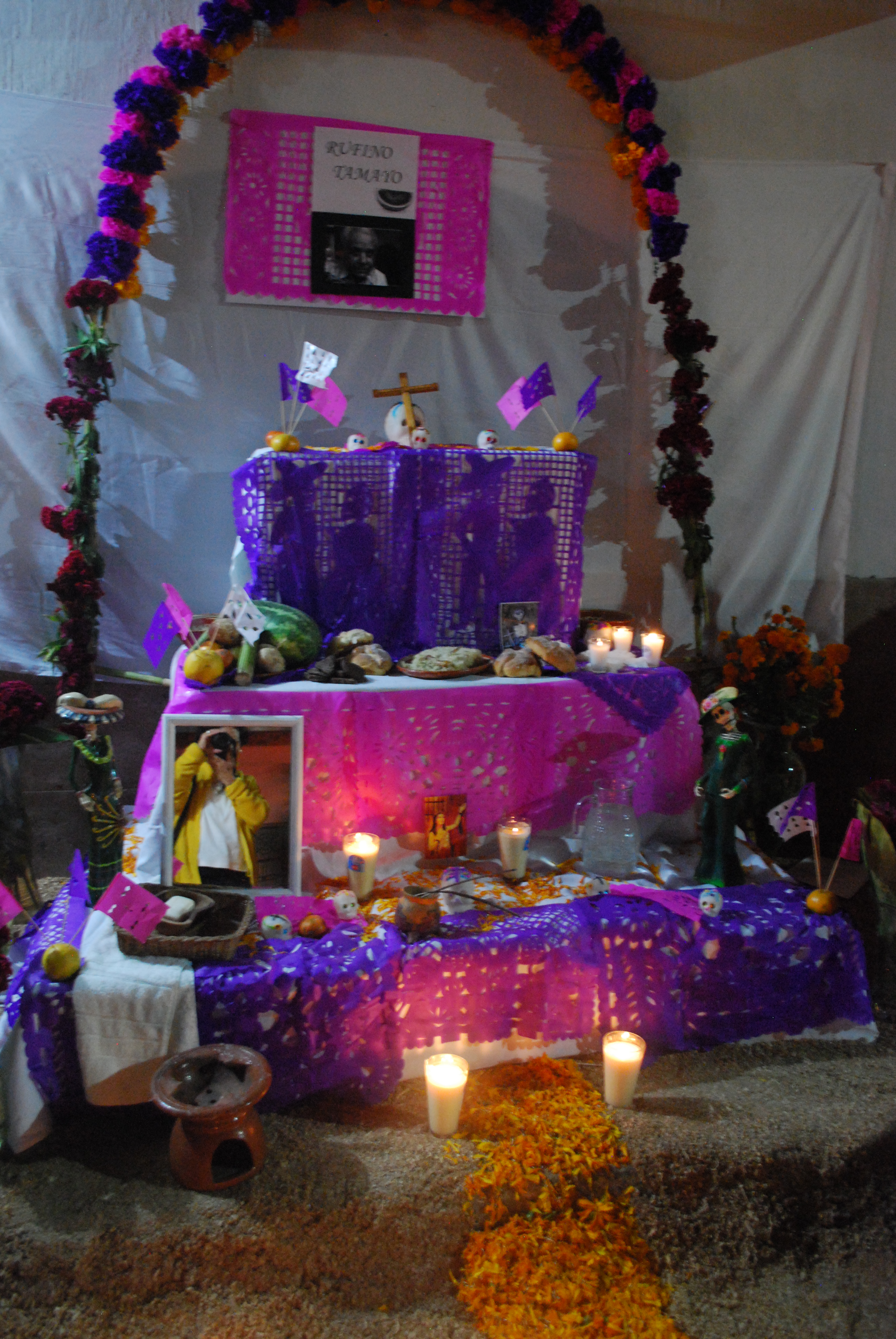
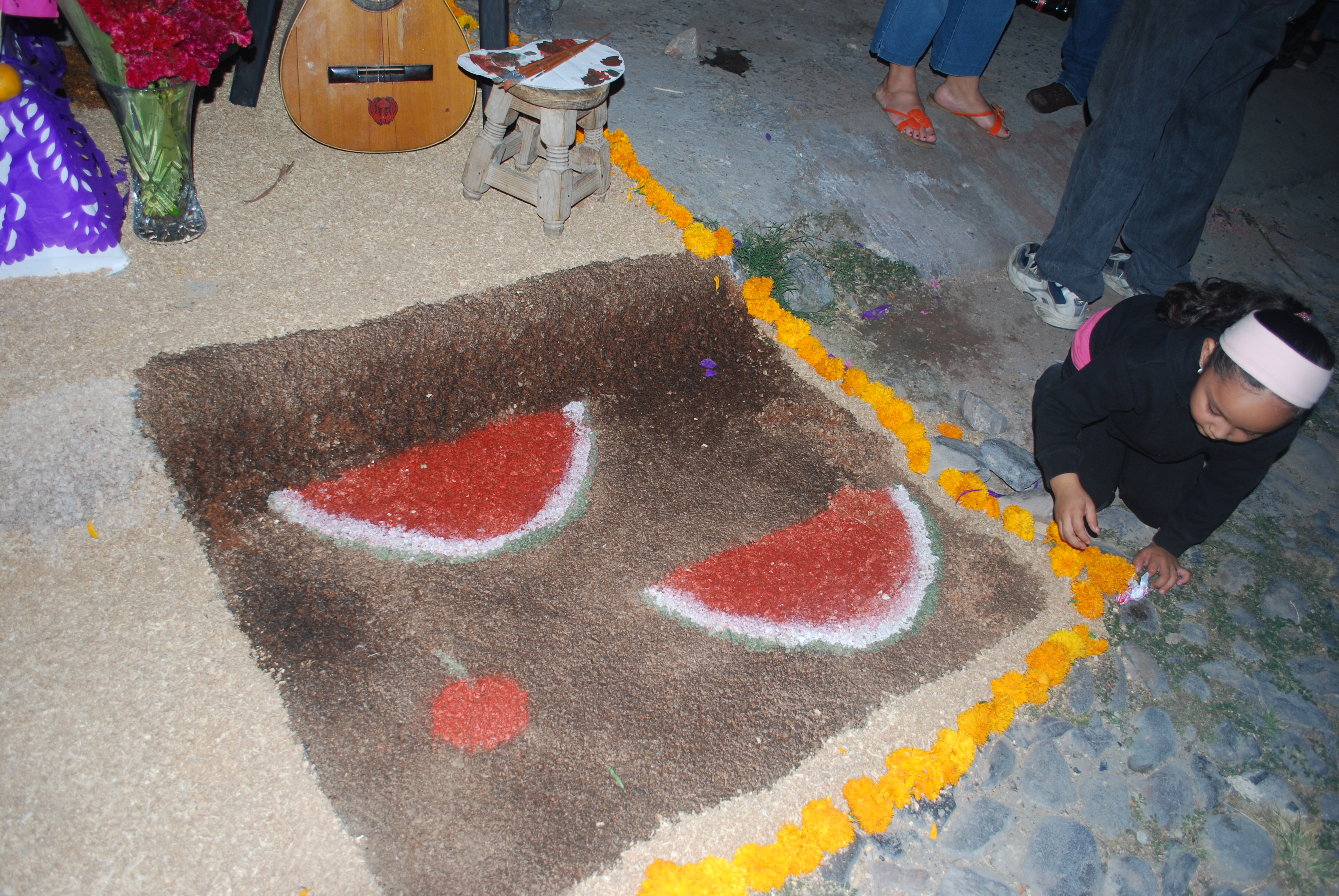
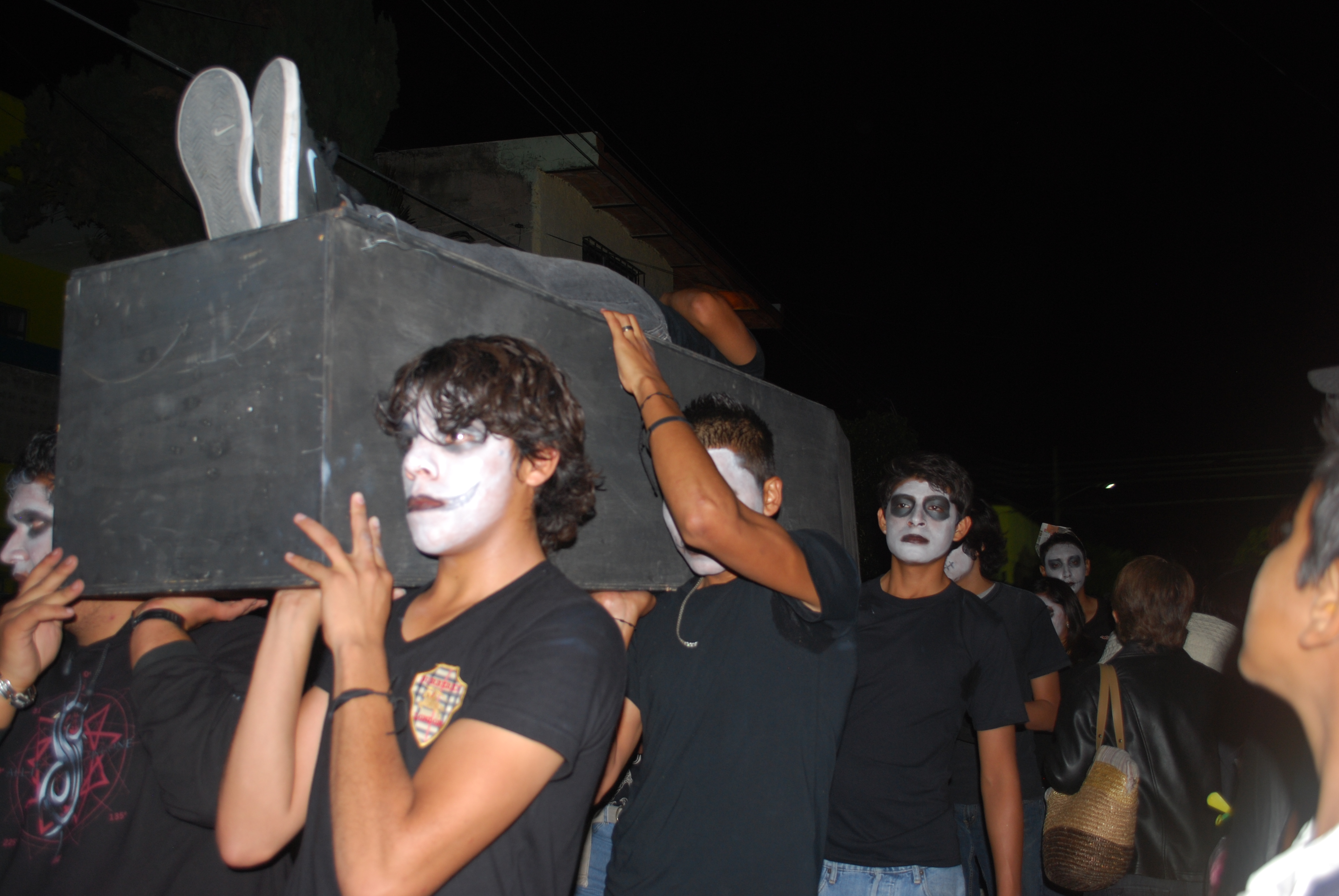
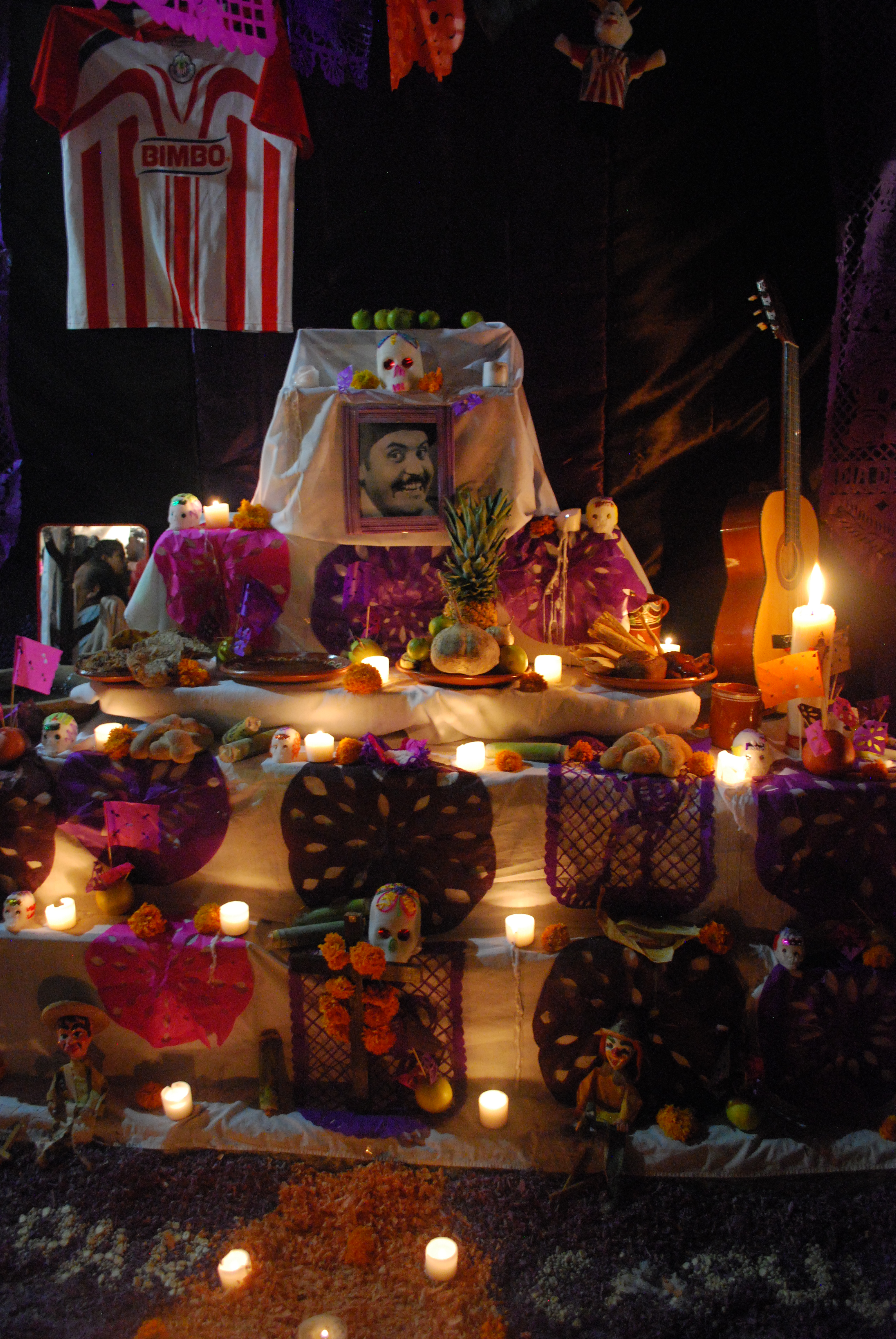
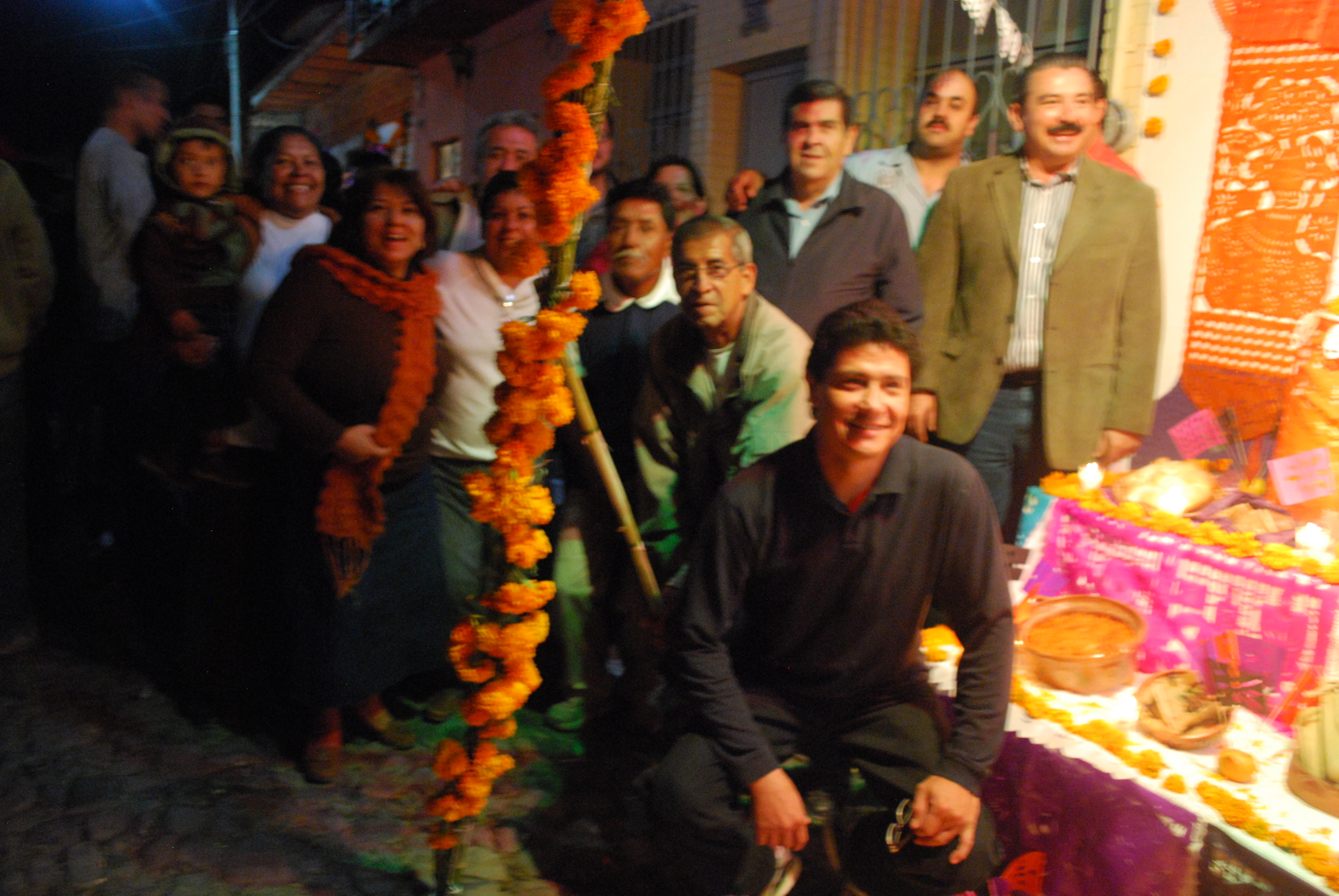
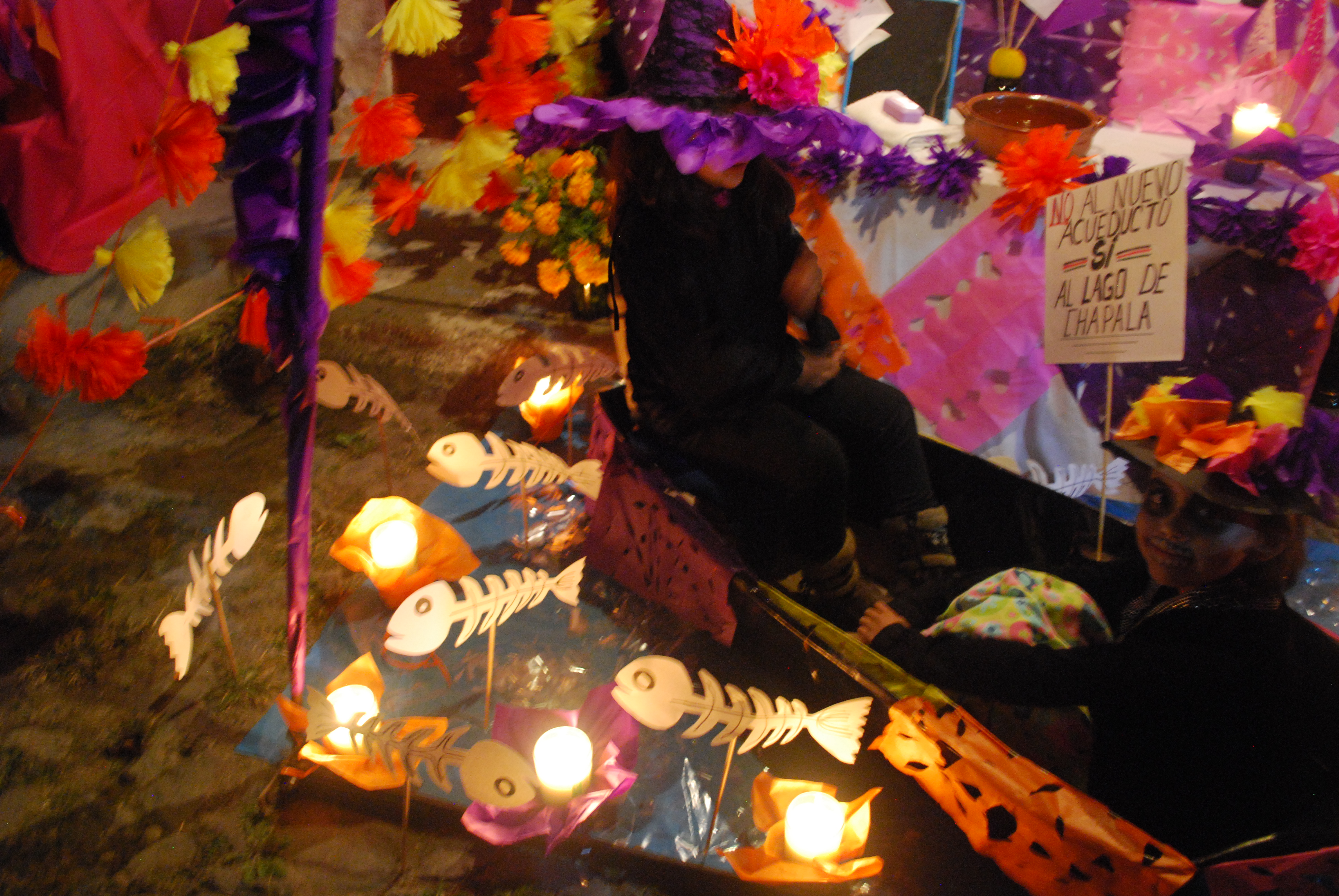
Every November in Chapala, the community puts up altars for Day of the Dead on one of the town’s main streets. It is just amazing to go over there every year and see what they’ve done; it’s always different from year to year. Some of the altars are traditional ones honoring departed loved ones – relatives, friends teachers, important figures in the area, even movie stars and famous singers. But some of the most interesting ones are political or social – this year there were altars and processions honoring those who have perished in Mexico’s drug wars, a wonderful altar to the great Mexican painter Tamayo; an altar to protest the very controversial proposed new pipeline which will take water from the lake to provide water for the teeming millions in Guadalajara. We love going every year; in spite of the not-always-for-the-best incursions of global monoculture into Mexican traditional life, Dia de Los Muertos just seems to keep hanging in there, and in many communities, as young people put their own stamp on this ancient holiday which combines elements of the pre-Hispanic and Spanish cultures. It is fascinating for an outsider to watch.

In Chapala, lots of people chip in money, time and effort to make these altars and then, once night falls and the candles are lit, people from all over come to walk the several blocks where the altars are set up to walk by them all and check them out, the same way we used to drive by over-the-top suburban Christmas light displays when I was a kid. There is music, little kids perched on their dads’ backs, teenagers hanging around (Sofia of course was there checking it all out with her school friends), people handing out traditional drinks and pieces of the traditional bread of the dead, pan de muerto, foreigners, dogs, everyone having a great time. Of course, at all the local cemeteries, the graves are still decorated, families come to the cemetery to visit their departed loved ones with food and drink, kids run around, and the traffic in front of the cemetery requires bunches of extra cops to manage the flow.

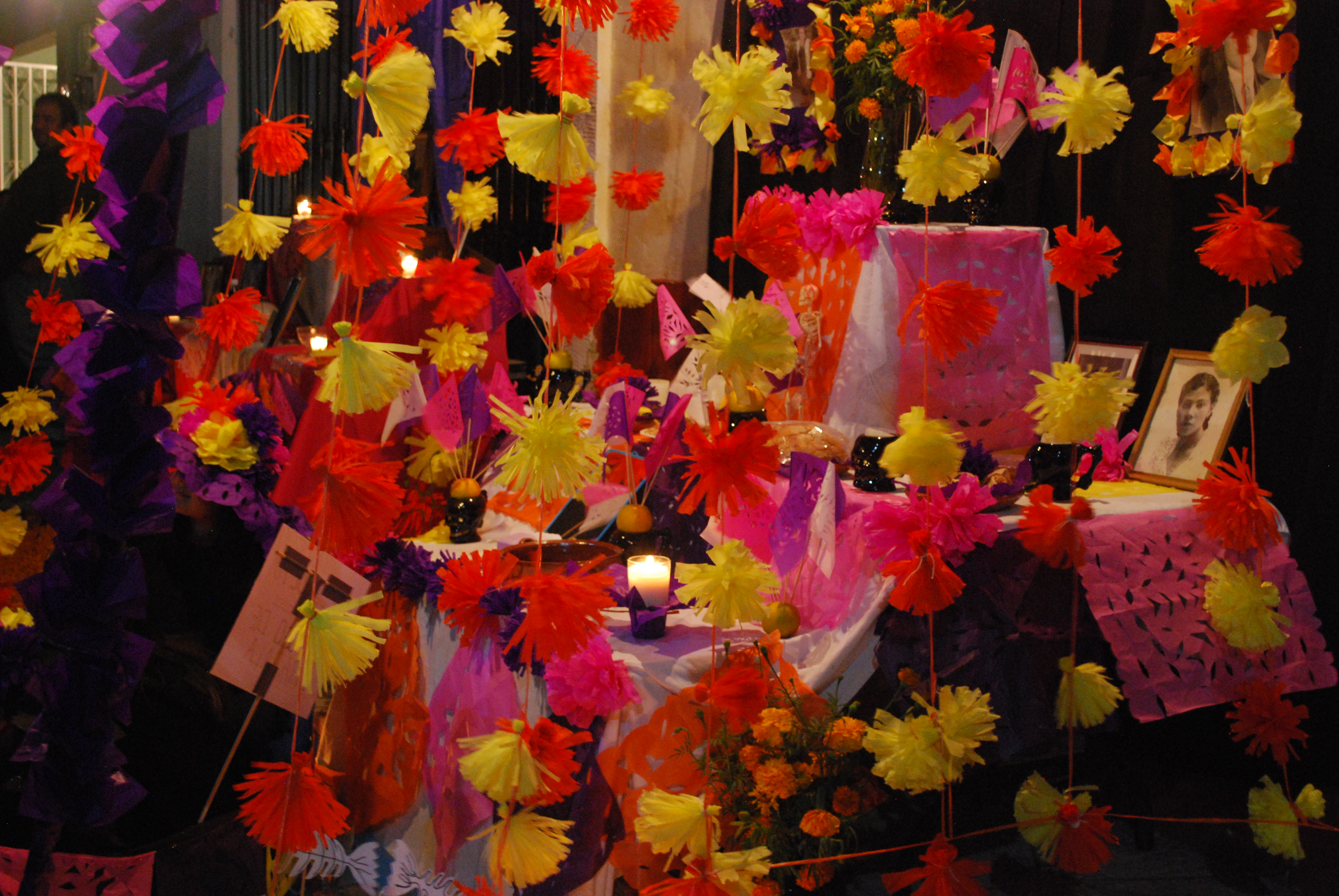
As with many contemporary manifestations of tradition, some things – remarkably – still seem fairly permanent. They say that the orange of the marigolds was a holdover from the Aztecs, who thought that the brilliant orange of the flowers would light the way for the spirits to come back to touch base with the living; the purple of course was the color of Christ and of Christianity; black for European notions of mourning, and so forth. Every altar pretty much as the requisite mirror (so the dead can spiff themselves up after the arduous  journey back here), soap, towel, comb and basin. The usually four levels of the altars also have meaning and were taken from Aztec tradition. And so it goes.


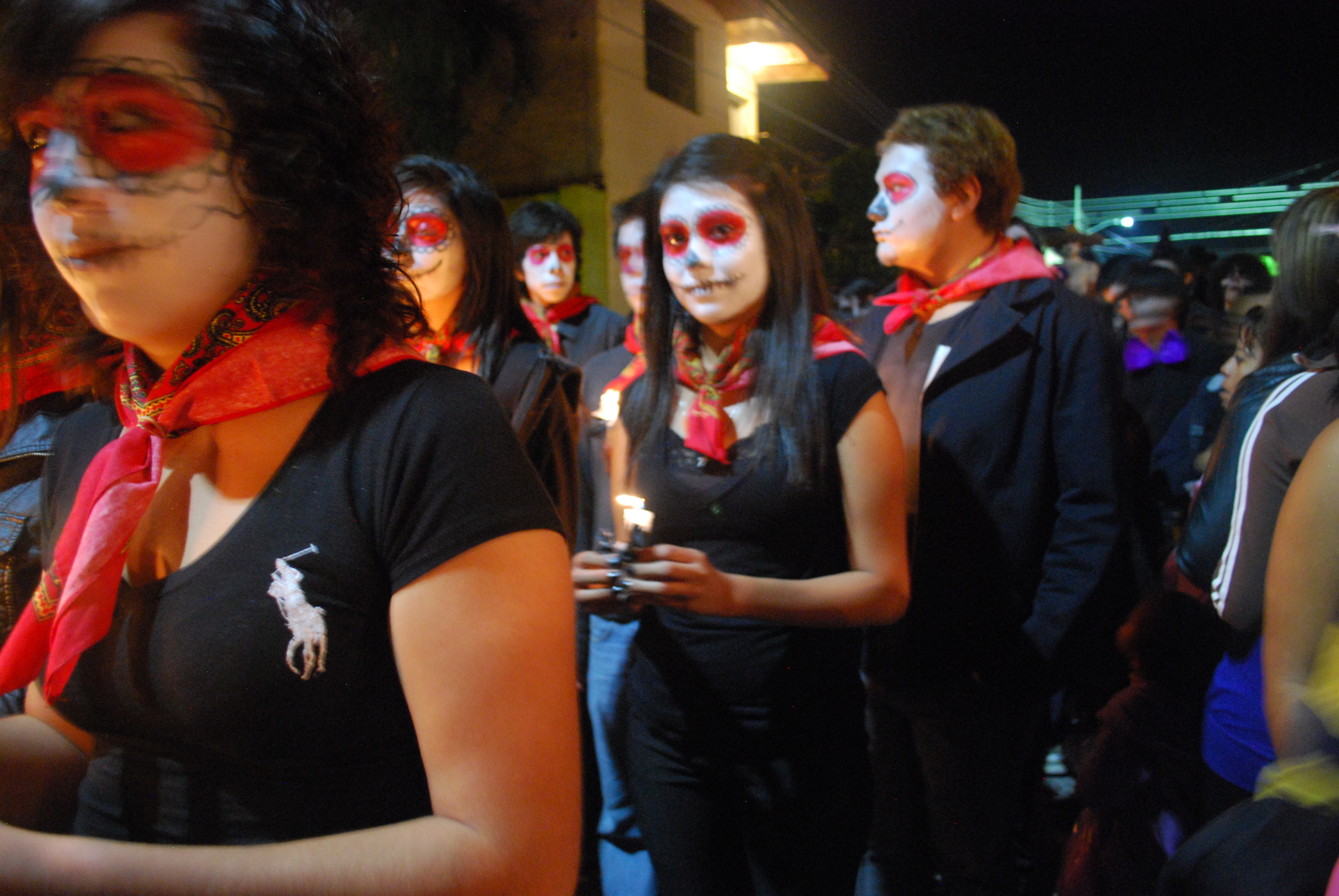
Kids love putting on face paint....


Altar commemorating a fellow who died from drinking too much....


Catrinas

Altar to victims of the drug war


Traditional altar

Altar for the great Mexican painter, Rufino Tamayo. That is ME with the camera reflected in the mirror!

Detail of the altar for Rufino Tamayo
Death to violence in Mexico
Traditional altar
Traditional altar
on Calle 5 de Mayo

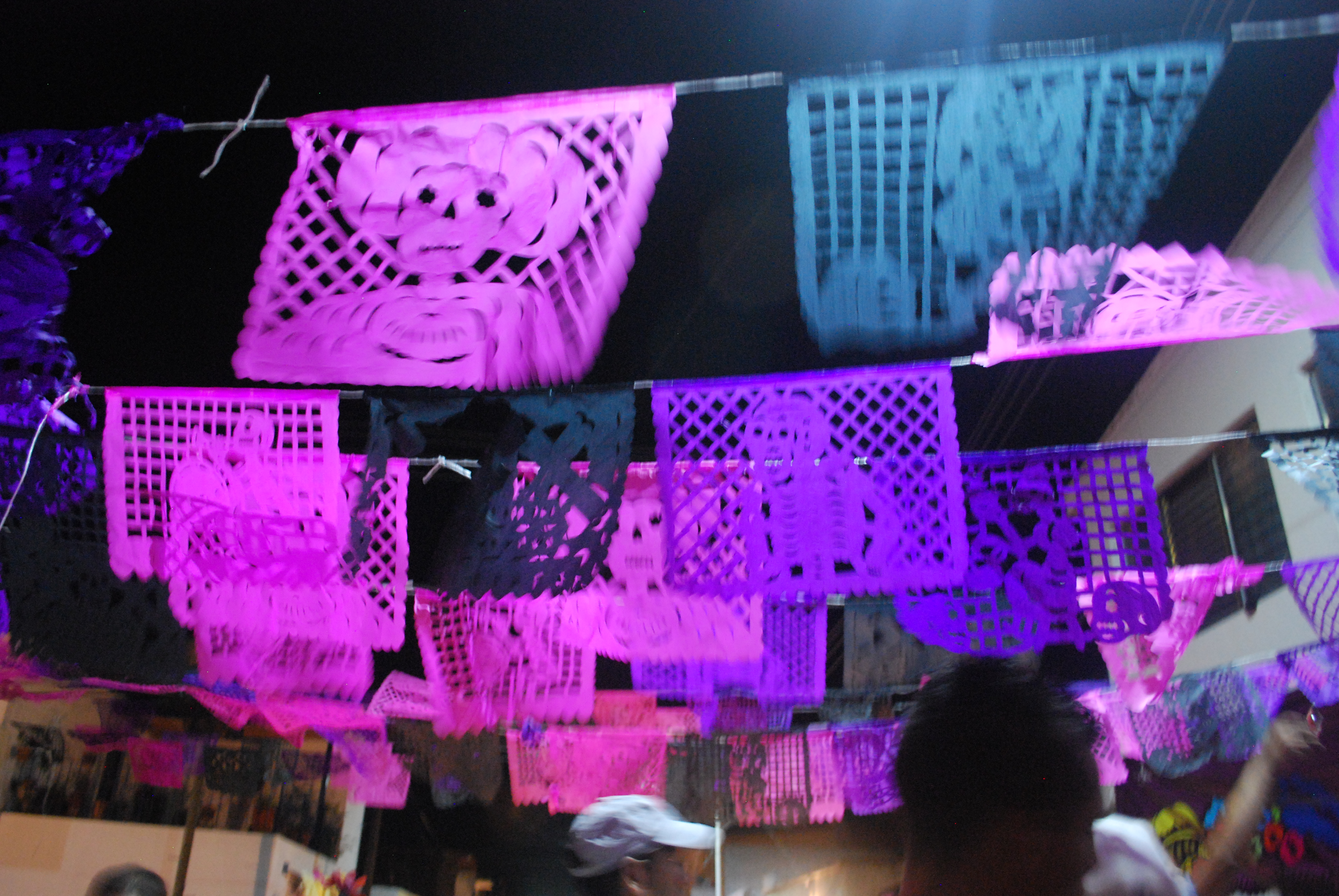
Papel Picado

Traditional altar

Parade of young people protesting violence in Mexico

Protesting the proposed new aqueduct taking lake water to Guadalajara

The Authentic and True Death is Forgetting

Rosa and Sofia

Moving to Mexico, one needs a maid. It is just written into the DNA of the culture that most “middle class” or “upper middle class” houses have maids. When I was a kid living in Mexico City in the ‘fifties we had two, an upstairs one and a downstairs one. They lived in a tiny little house in the back where the stone laundry sink was. Their quarters were very basic, to say the least. Our downstairs maid, Rosa, was just a couple of years older than I was, and we got to be pretty good friends talking about boys and clothes and makeup (which my mother disapproved of; she didn’t like me getting to close to the “help”.) The upstairs maid was Cuca. Refugio was her real name and I always wished someone would have named ME Refugio, but nice Jewish girls didn’t get names like that, or at least the ones from Encino like me. Maybe if I’d been Sephardic. Cuca was in her sixties at that point and was the only illiterate person I had ever met (granted, I was only twelve) and it fascinated me how she managed to answer the phone, take messages and navigate in the city.

In any event, landing in Mexico again fifty years later, we still needed a maid. One of our friends had a terrific maid who needed some extra work, so she joined our household, though nowadays most maids don’t live in, unless the house is a pretty big one. Rosa, who comes to clean three days a week, and stays here to guard the house when we are traveling, turned out to be an even better friend to me than the earlier Rosa had been. She is one of the most intuitive and sensitive women I’ve ever met. Now in her late forties, she was forced to drop out of school in the second grade because “girls don’t need to go to school” and because her family was so poor they couldn’t afford shoes and school supplies, let alone uniforms and the modest fees the Mexican primary schools require. She somehow taught herself to read and write and though she is more than bright enough to have done any number of things, her lot was to clean houses. She does this with dignity and grace and we have become very fond of her over the years.

Sofia (2009, age 13) and Rosa

Rosa of course got married way too young. She had a male child who died, but her other three daughters survived: Mireya, Gaby, and the baby, Sofia. Rosa had to endure quite a bit of rejection from her husband and his family because she never produced another boy. She couldn’t really move out, but she did manage to have as little to do with her husband as possible and swore to herself that if nothing else, she would raise her three girls without violence. She decided she would never, under any circumstances, hit them, and she never has. The two older girls now have children of their own (more on them later!) But when I got to know the youngest child, Sofia, she told me that all she wanted to do was study, that she didn’t want to be dragged down with babies like the others. She was afraid that she wouldn’t be able to go to secundaria (middle school) when the time came, because her mom was “just a maid” and even though she was at the top of her class and her school, she was not certain that she would be able to continue.

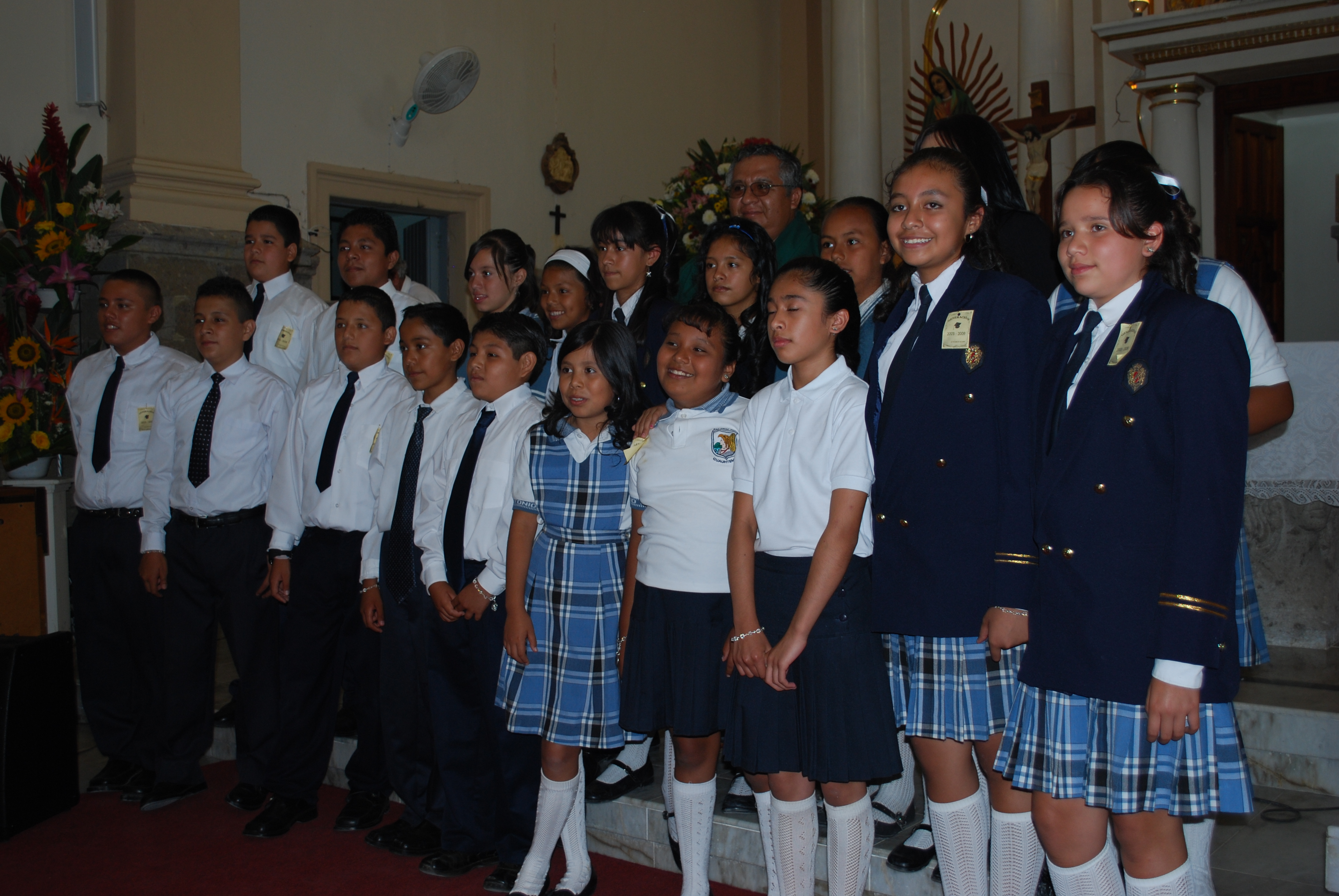
Me, Sofia and Arnold at her Primary School Graduation

Sofia's Graduating Class - Primary School

Of course, Sofia was smart enough to come to me! (She probably knew a sucker when she saw one). I told her that if she continued to keep her grades up, Arnold and I would help her stay in school and we’d help her go as far as she wanted. We began to help with tuition, uniforms, books, and other expenses through one of the local charities that exists as a go-between to help expats who want to provide that sort of assistance to deserving kids in the local public schools. That arrangement went on for a couple of years, and Sofia continued to do well academically, but we could see that she was utterly alone, without any friends, and I suspected underneath it all, she was pretty depressed. The girls were all pairing up with boys and the pressure was on her to find a “novio” pretty soon. She hated the whole business.

I felt that the time might be coming to yank her out of there and try to get her into a better school where she would meet kids from families who expected their children not only to finish high school, but to go on to college, since while she couldn’t fully articulate it, I knew that was what she wanted for herself as well. I wangled a meeting with the headmaster of one of the good private schools here, and showed up with Sofi’s grades, her “reconocimientos” (awards) and helped Rosa fill out an application for a scholarship. Sofia was accepted and given a 50% scholarship – we and other friends are making up the difference. Since she has been at the new school, she has been a whole new kid. For the first time in her life, she has friends – gobs of them, and a real social life. She loves it there.

We are about to get her first set of grades since she made the transfer – we’ll see soon how tough the coursework has been for her and how difficult the academic adjustment has been. But it has been fun to see her blossom into a regular old teenager, complete with a “crowd” of girls to hang out with, occasional bouts of predictable moodiness, and a keen desire to have the coolest clothes she can possibly scrounge together. Her new friends, most of whom come from far wealthier families, have been very kind to her and welcomed her into her new “salon” (class) with open arms. She was terrified of course, and so was Rosa, that it would be hard for her to make that social leap. Rosa and Sofia share a bed in Rosa’s tiny house; all Sofia wants is a bed and a room of her own someday. At least planning to go on to college, she may have half a chance of actually getting one.

Back home (wherever that is…)

Going back to the States is always so complicated….we get off the plane, we readjust to everyone speaking English, we hit the stores the second we unpack to begin stocking up on whatever we are missing. We dive into the retail offerings like children going after whatever a smashed piñata has scattered to the ground; then when we raise our heads from the bins and racks and go outside to whichever street it is, we marvel at the cleanliness and orderliness of it all…no plastic bags and empty bottles scattered around, no dead dogs by the side of the road, no dusty garbage heaps covered only by the weeds the current rainy season has so generously helped to cover.

We see family and friends and catch up on everything and wish, for a moment, that our lives had been different; that we had gone to the right schools and gotten the right degrees and had a life that would have enabled us to stay in our Ancestral Homeland with comfortable retirement funds and the luxury of living in one of these great cities without having to work and be in front of a desk every day despite blizzards or flu or rain or just not feeling like it that day. But our lives turned out to be vastly, vastly different. Who knows why?  There are hints, of course. Firstly that I had lived in Mexico as a kid, and loved it here. Did NOT want to come back to the U.S., having no interest in being an American teenager. I knew that any attempt short, dark, chubby ME would make at fitting in to a life where the kids were pert, blond, long-limbed and not particularly interested in listening to Beethoven or opera at age 14 was going to be a colossal failure. And in that, despite my youth, I was correct.

__________________________________________________________________________

So for many reasons my destiny was to keep moving; away from New Haven, where I was born (and where one branch of my family still lives), to Los Angeles as an infant with my parents; then away from there to college in Boston; then away from there to San Francisco to put my then-husband through graduate school and begin a range of challenging – and rather interesting – bunch of varied jobs doing all sorts of things. We left Oakland for Santa Fe. And fifteen years into our Santa Fe life it occurred to us that the reason we had liked it so much was that it was about as close as you could get to living in a foreign country and not leaving the U.S. That, of course, begged the question “well, why not GO to a foreign country, then?” We made trips to Italy, to Germany, to France, and imagined ourselves living in all the cities where we rented apartments for a week or two. But Mexico was the most practical – my parents were both alive and needed constant attention and monitoring of their care back in Santa Fe; I still had to work enough to help bring in some income, and quarterly trips back to the U.S. were mandatory, at least for a while.

Thus it was that in 2006 we sold our house in Santa Fe, packed up our stuff and the cats, and headed south to see what Mexico could offer us in the way of a new life – willing to trade off the conveniences of our American life for the freedom of ditching the day jobs, the mortgage, the car payment, the stress.

So far, the tradeoff has been a good one.

Carnaval parade, February 2009

October 12, 2011 – Plane landed, and the bus takes us to Customs as usual. Was prepared for the usual “we are back in this crazy place, maybe we should have stayed in the States, it is so nice and clean and orderly there” feelings I always have when we come back from a trip. But was immediately distracted from all that by brand new desks for the customs agents and spiffy new uniforms for the porters that are white mariachi shirts and traditional red bow ties! They look terrific, handsome and eager to help. Got outside looking for Luis to take us home but he wasn’t there, but found his brother Miguel, assigned to bring us home. With him was his five-year old son Ivan (more often than not, Mexico has Bring Your Child To Work Day) who delighted us the whole way home by telling us how in kindergarten he has now learned to count forward AND backward from zero to twenty, how he has learned his colors and one-two-three-four-five in English, and how he has a new game which involves buying and selling toy cars and he has to learn the “marcas” of every single car on the road in order to play it. So it was “that’s a Ford!” “That’s a Chevy!” all the way home. His father said “Hijo, fasten your seat belt and then count from twenty to zero backwards for the Señor and the Señora”. This Ivan did, several times.

We got home, Rosa opened the gate when we rang, and the first sound I heard (other than Reina barking) was the splashing of our fountain. She threw her arms around us and insisted on dragging the suitcases into the house across the courtyard, through the pathway littered with the fallen orange blossoms of our galeana tree.. Maybe this isn’t so bad after all, I thought.

¡Hola! We Are Still Here…


Since my husband Arnold and I moved to Mexico (from Santa Fe, New Mexico) in 2007, any number of our friends have asked me “why don’t you start a blog?” Truthfully I never really considered it because I kept thinking “oh, honestly, all those ‘We restored a wrecked house in (insert name of exotic foreign country)’ books have been written, and they were pretty much all far better than what I could have written. But when we’d see friends back in the States, or they came to visit us here, and I would tell stories about this or that thing that happened to me (they really loved the tale of the carjacking-at-gunpoint I endured a few years ago, it was much juicier than the dishwasher blowing up). Anyway, folks have persisted and at least for the moment, overridden my “who cares about my little life?” protests, so here I am.

My family lived in Mexico City in the ‘fifties and I certainly must admit that I came to our present expat adventure with certain advantages: I knew and loved Mexico, even though it was the Mexico I remembered from childhood and quite different from Mexico in the 21st century. I spoke the language, loved the weather and the aesthetic, and I learned the first time around that I could survive and thrive here. In fact, now that we have indeed been here for awhile, I actually feel that I may have developed a better instinct for interpreting what I see around me. My Spanish is much better now, even Arnold, my husband, is much more comfortable here. It is an interesting time to be living in Mexico and it is also an interesting time to be viewing the events back in the U.S., our Ancestral Homeland, from another perspective. Now, here we are, in this no-longer-third-world-but–not-first-yet-either country, with a front row seat.

So, welcome to my new blog; let’s see how long and if I keep it up!

Sunset over Lake Chapala - the view from my office window.

Sunset over Lake Chapala – the view from my office window.